How to Stop Bleedthrough on Painted Furniture: Causes, Fixes & Best Primers (A Complete Guide)
You spent hours painting the perfect dresser… only to wake up the next morning and find ugly brown, yellow, or pink stains bleeding right through your fresh paint project. Sound familiar? Don’t panic—it happens to every furniture painter at some point, and the good news is it’s completely fixable. After refinishing furniture for more than 14 years, I’ve dealt with bleedthrough on everything from pine dressers to mahogany tables, cherry cabinets, and more. I’ll show you exactly how to stop it for good!
**Updated July 21, 2026: I’ve refreshed this guide with new troubleshooting tips, additional examples, and answers to the most common questions I receive about furniture paint, primers, and bleedthrough over the years. If you have any questions or thoughts on this guide, I’d love to hear from you in the comments below.
In today’s post, I’m also sharing –
- What causes bleedthrough?
- Which woods are most likely to bleed?
- The products that actually STOP bleedthrough.
- What to do if bleedthrough appears after painting?
- Examples of MY bleedthrough projects and how they turned out.
- And more!
*As an Amazon Associate, I earn from qualifying purchases. There are affiliate links in this post to other companies/products I use and love as well. You will never be charged extra when you purchase through these affiliate links. If you purchase from my links – A BIG thank you for supporting me and the #siblog! To see my full disclaimer, click here.
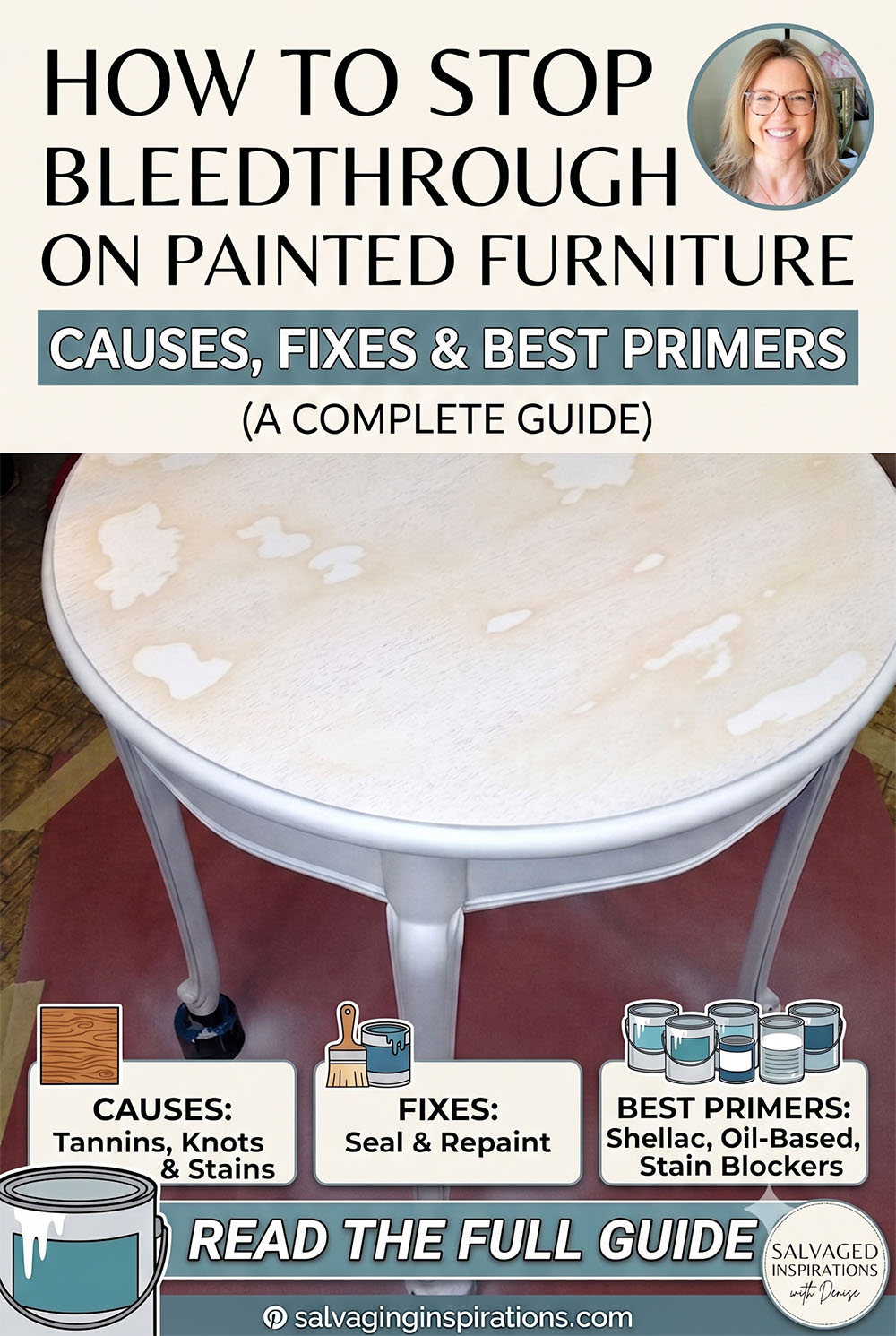
WHAT CAUSES BLEEDTHROUGH?
Bleedthrough is any unwanted stain or substance seeping into or showing up in a space where it shouldn’t be. Most posts only mention the tannins in wood when describing bleedthrough stains appearing after they prime or paint. And for most of my furniture makeovers, this has been the case. But I’ve also experienced bleedthrough caused by oils, nicotine, smoke damage, old furniture polish, and water stains.
Bleedthrough on furniture can be caused by-
- wood tannins
- oils
- nicotine
- smoke damage
- old furniture polish
- water stains
WHICH WOODS BLEEDTHROUGH THE MOST?
After working with many types of wood furniture, I’ve found the most notorious bleeders are –
- Mahogany – shows up as red/pink staining
- Cherry wood – usually shows up as pink/orange stain
- Oak wood – shows up as brown/yellow stain
- Knotted Pine & Soft Woods – the knots can show up dark due to sap
- Cedar & Redwood – shows up as yellow/brown/red stains
HOW TO TELL IF A PIECE WILL BLEED *BEFORE* YOU PAINT
When I’m working with a real wood piece or wood veneer, I air on the side of caution and prime. A few good tests I’ve learned over the years is older wood furniture often made from the list above are bleeders. Also, if I start cleaning the piece and my sponge and water turn tinted, I know it will bleed. Also, there have been times when I’m cleaning a piece and everything looks perfect because the topcoat is still protecting. But once I sand, the exposed raw wood will cause bleedthrough of my paint or primer. If you’re on the fence, I would use a stain-blocking primer. It will save you so much time in the end.
CAN I PAINT OVER BLEEDTHROUGH?
NO… and believe me, I’ve tried, and it has never worked. When I first started painting furniture, I can’t tell you how many times my paint job looked gorgeous, until I came back down the next morning only to see it looking blotchy and stained. And no matter how many coats of paint I tried to cover it with, that stubborn stain kept coming back. This is because bleedthrough is not a coverage issue; it’s a reaction. Moisture from paint products contributes to the stain pushing upwards and bleeding through the surface. Adding more coats of paint will activate and feed the stain.
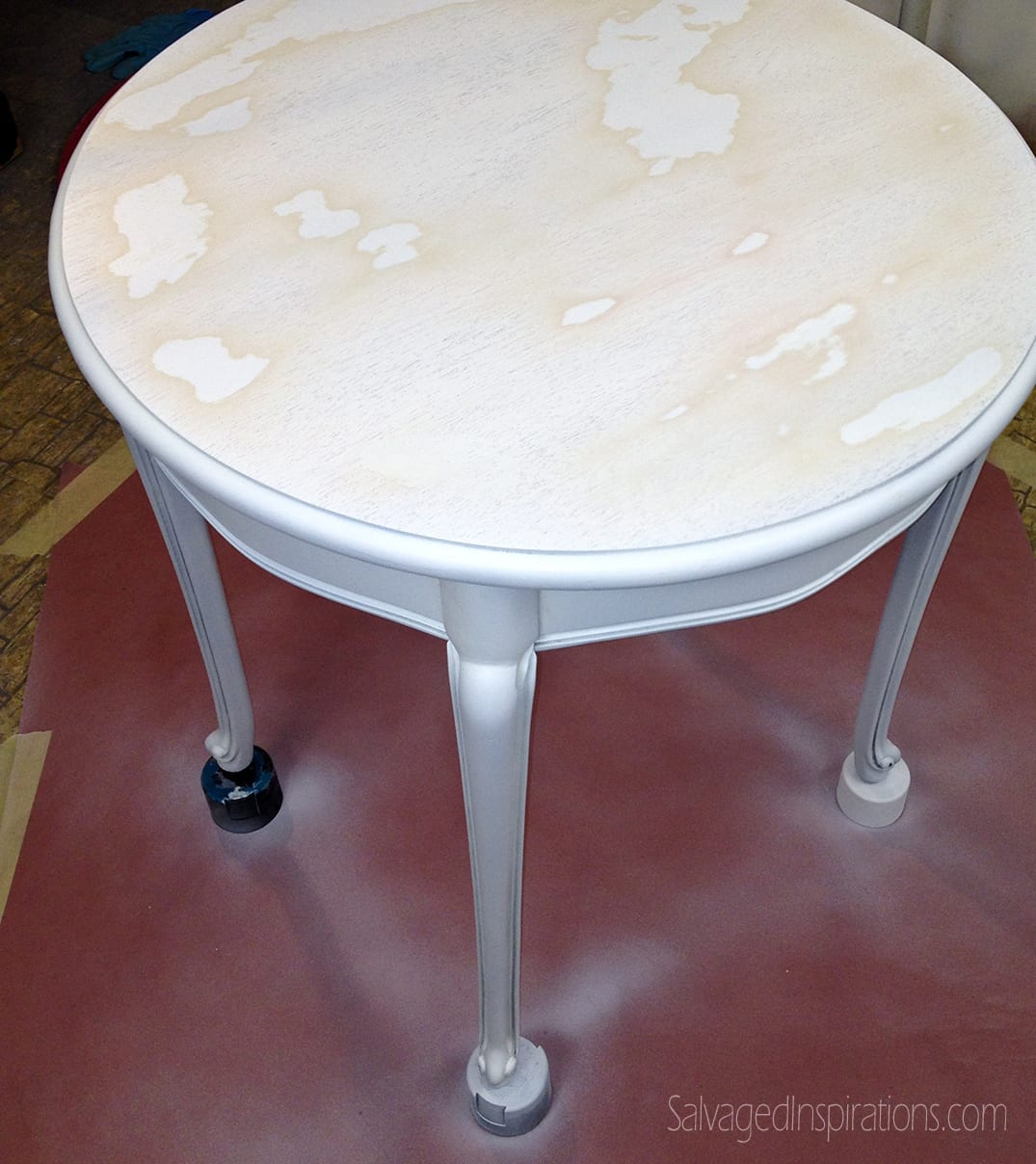
BEST PRIMERS FOR BLEEDTHROUGH
I’ve used numerous brands of primer over the years. My go-to’s have been BIN Shellac-Based Primer for speed, stain blocking, and bonding. The downfall is that there is a strong odour from the shellac fumes, so good ventilation and a safety mask are required.
For a water-based stain blocker and bonding primer, I use this Bonding BOSS Primer. Easy clean-up because it’s a water-based product. No fumes or odour. It can be used indoors safely. However, it does take longer to work – 24 hours is recommended.
For spot fixes, clear Shellac does a really good job. For me, this takes a little guesswork though. I don’t get a visual (usually applying thin coats is plenty, whether by spray or brush on), but there was a time I applied it too thick and my paint finish ended up cracking – a crackle paint finish.
My Go-To Products
Best overall for stubborn bleedthrough: BIN Shellac-Based Primer
Best lower-odor alternative: Bonding BOSS
Best for spot treating knots: Clear Shellac
Best when I need to see the bleedthrough stop: BIN because you can visibly see the stains being blocked
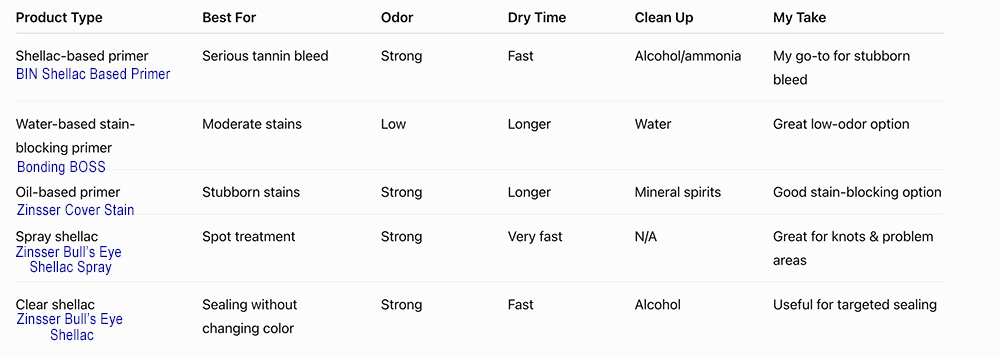
PIN FOR LATER! 🤗
Here is a guide for an overall quick look…
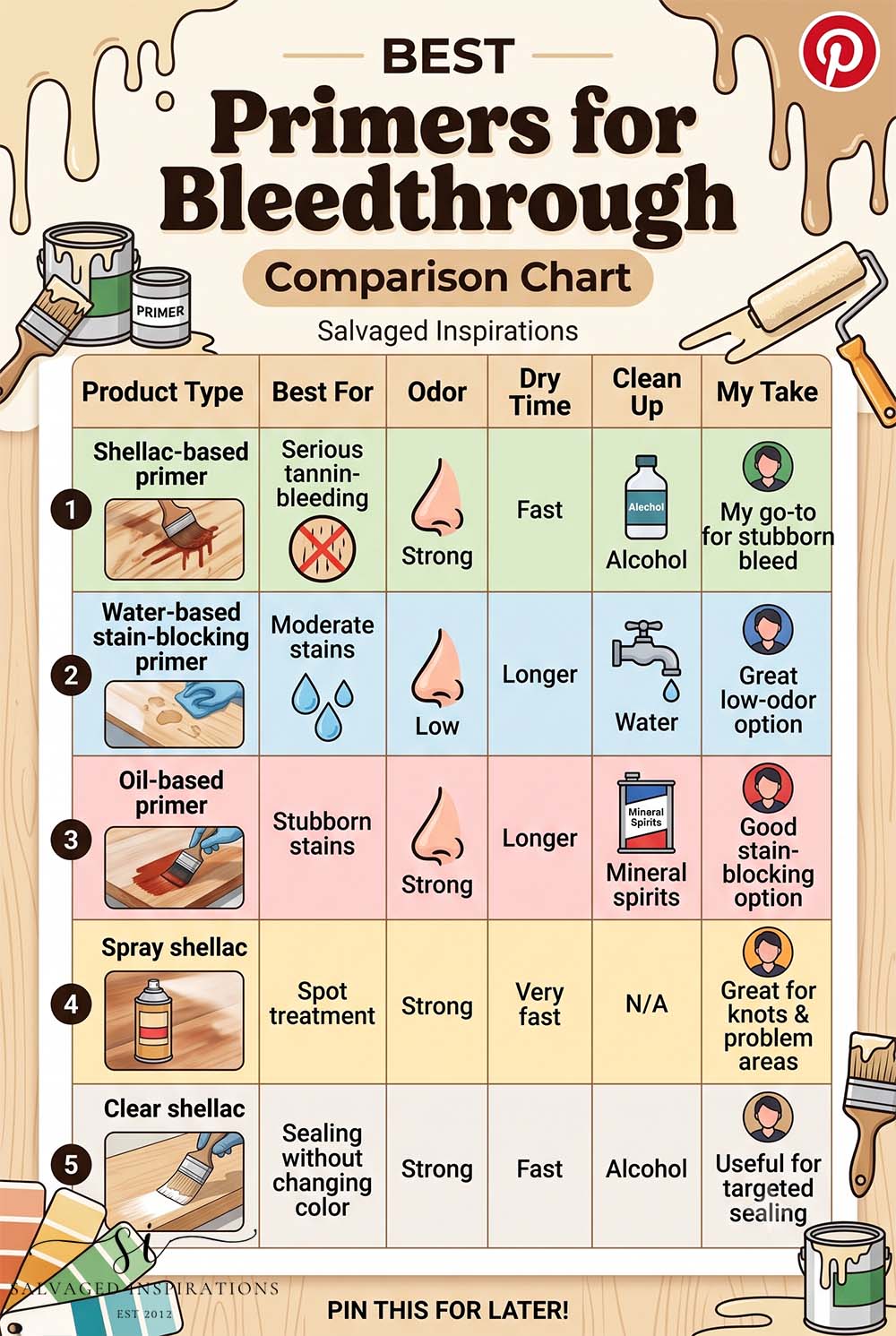
MOST FAQ I’VE RECEIVED OVER THE YEARS
How Many Coats of Primer Do I Need?
There is no steadfast rule for the amount of coats I use to prime furniture, but usually one to two coats will do the trick. Another thing I do is to really LOOK at the furniture surface. If I see a stubborn stain still showing, this tells me if an additional coat or some spot treatment is needed.
- Mild bleed → 1 coat may be enough
- Moderate bleed → 2 coats
- Severe/stubborn bleed → 2–3+ coats or a different product
- Spot bleeding → targeted treatment may be enough
- Don’t count coats. Look at the furniture!
What’s the Difference Between Bonding Primer and Stain-Blocking Primer?
A lot of new furniture painters don’t realize that: Bonding primer and stain-blocking primers are two very different things. A bonding primer is primarily designed to help paint adhere to difficult surfaces. A stain-blocking primer is designed to prevent stains from migrating through the finish.
Some products do both, but they aren’t automatically interchangeable.
- If your problem is adhesion, you need a bonding solution.
- If your problem is bleedthrough, you need a stain-blocking solution.
If you’re dealing with both, look for a product designed to handle both challenges—or use the appropriate products in sequence.
I Already Painted It, And It’s Bleeding—Now What?
What to do when bleedthrough appears after painting:
Step 1: Stop adding paint.
Don’t apply another 3 coats hoping it disappears.
Step 2: Let the paint dry completely.
You want to make sure you’re looking at actual bleedthrough and not a wet or uneven paint layer.
Step 3: Identify the cause.
Is it tannin? Oil? Water? Smoke? Furniture polish?
Step 4: Apply a stain blocker.
Depending on the severity, use a shellac-based, oil-based, or other appropriate stain-blocking product mentioned above.
Step 5: Allow it to dry/cure according to the manufacturer’s directions.
Step 6: Repaint.
Do you need to sand the bleedthrough off first?
If the surface is smooth and the issue is simply staining migrating through, you may not need to sand the entire piece back to bare wood. But if there’s bubbling, peeling, roughness, or a contaminated surface, that’s a different situation. This indicates that sanding is required.
Why did my primer fail?
Here’s a troubleshooting section if you notice bleedthrough AFTER you’ve already primed…
If bleedthrough is still showing after priming, ask:
- Did I clean the furniture thoroughly enough?
- Was the surface contaminated with wax or silicone?
- Did I use the right type of primer?
- Did I apply enough coats?
- Did I allow enough drying/curing time?
- Was the stain still active underneath?
- Did I paint over the primer too soon?
What I Would Do…
If this were MY piece…
Painting white over mahogany?
I’d go straight to BIN Shellac-Based Primer.
Painting an old pine dresser with lots of knots?
I’d spot-treat the knots first with spray shellac, then prime with BIN.
Painting a vintage piece with a strong smoke smell?
I’d clean aggressively, address the odor, and use a primer designed to block both stains and odor.
Painting a piece with only a couple of small stains?
I’d spot-treat rather than automatically priming every inch.
A FEW OF MY EXPERIENCES OVER THE YEARS
I’ve painted countless projects. And over the last 14 years, I’ve had numerous projects where I needed a stain blocker before painting. I’ve also painted, and THEN realized I needed a stain blocker. And the very worst, I’ve painted, started topcoating, and THEN the bleedthrough reared its ugly head!
Below are a few examples where this ugly staining was a real issue… and how beautifully they all turned out in the end.
WHITE PAINTED CHINA CABINET
Here’s an oldie but a goodie! I found this vintage china cabinet at my local Restore. These old pieces are notorious for bleed-through, but even so, I absolutely love working on them.
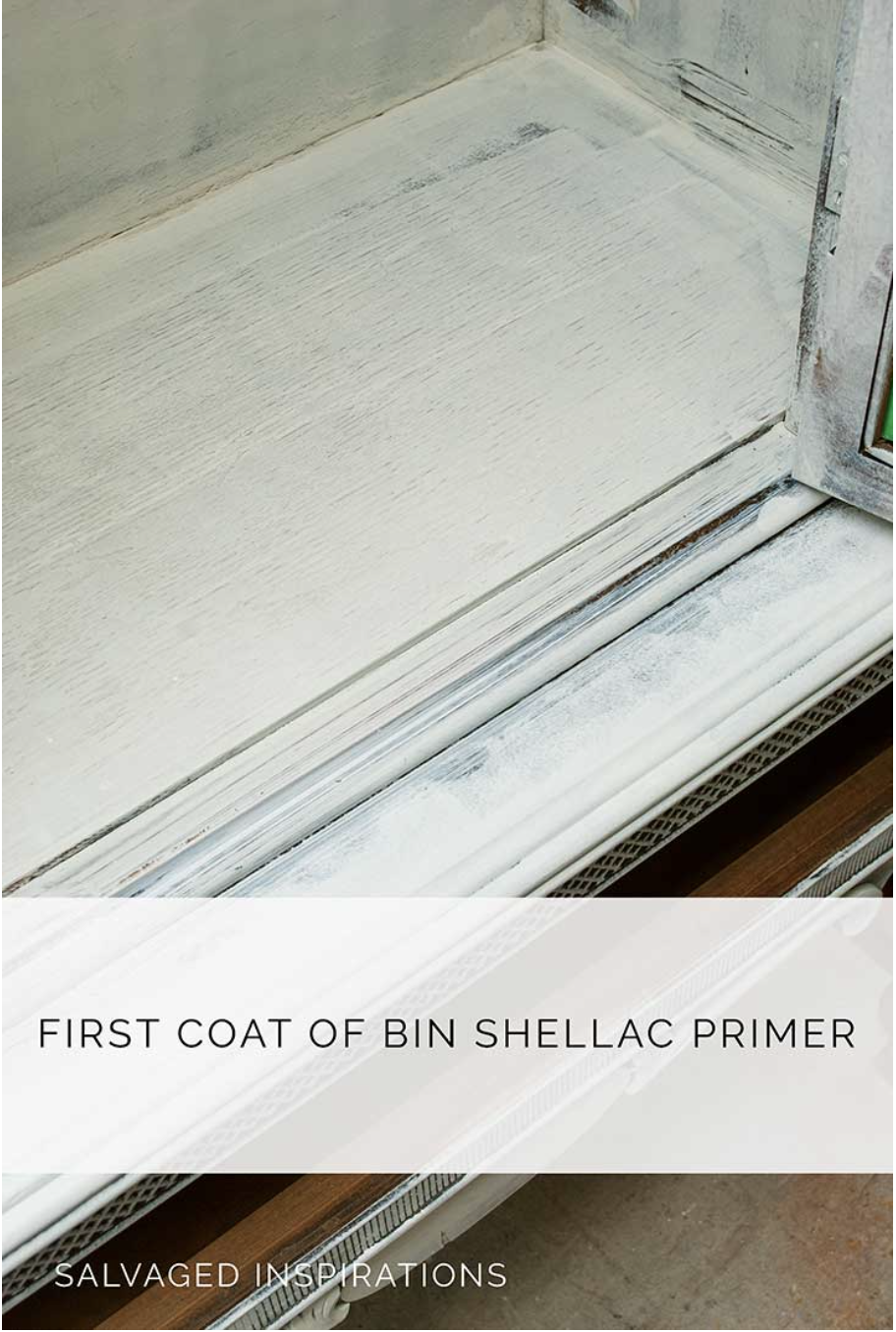
Below is all the staining that popped up after applying the first coat of BIN Shellac-Based Primer. The benefit of using BIN Shellac-Based Primer is I can actually SEE when the bleed-through is 100% covered – unlike some other primers where it’s a bit of a guessing game.
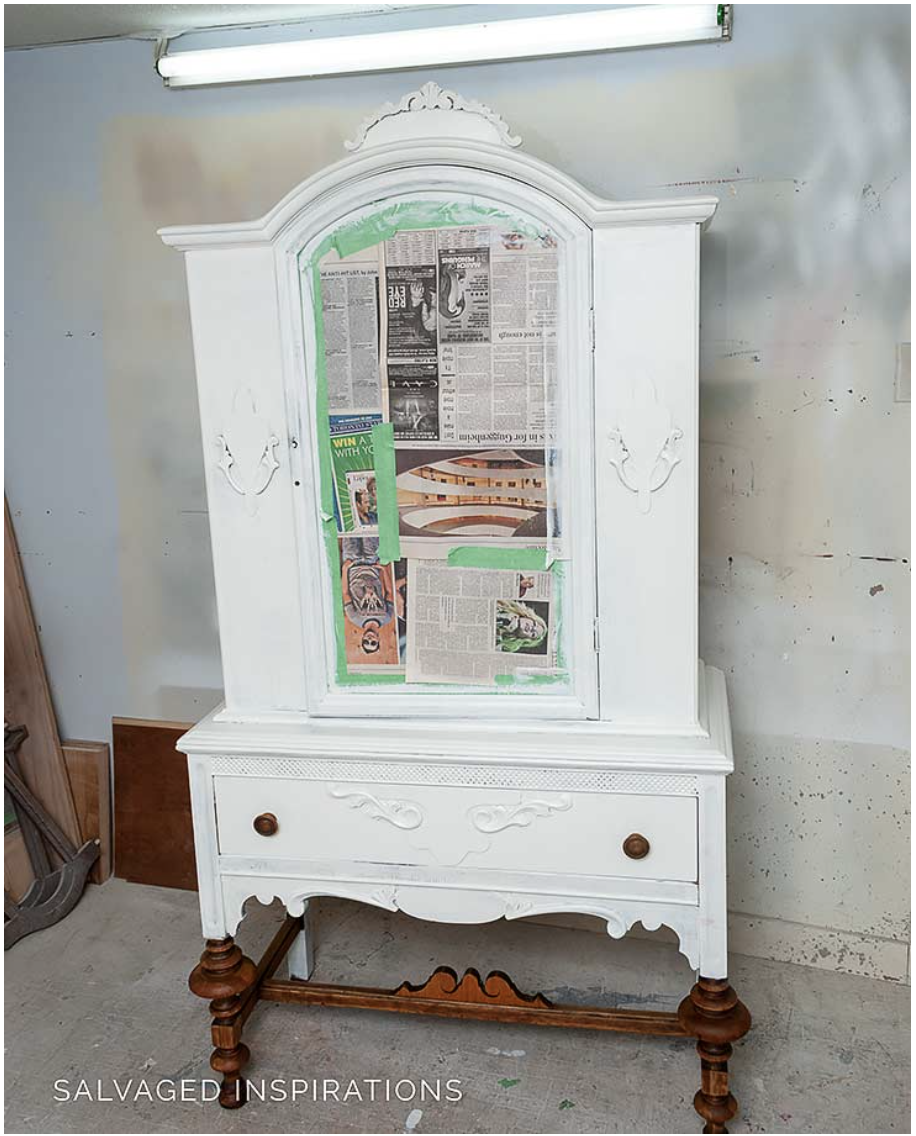
After the second coat of BIN primer was applied, there was NO staining visible, and that was my green light to start painting.
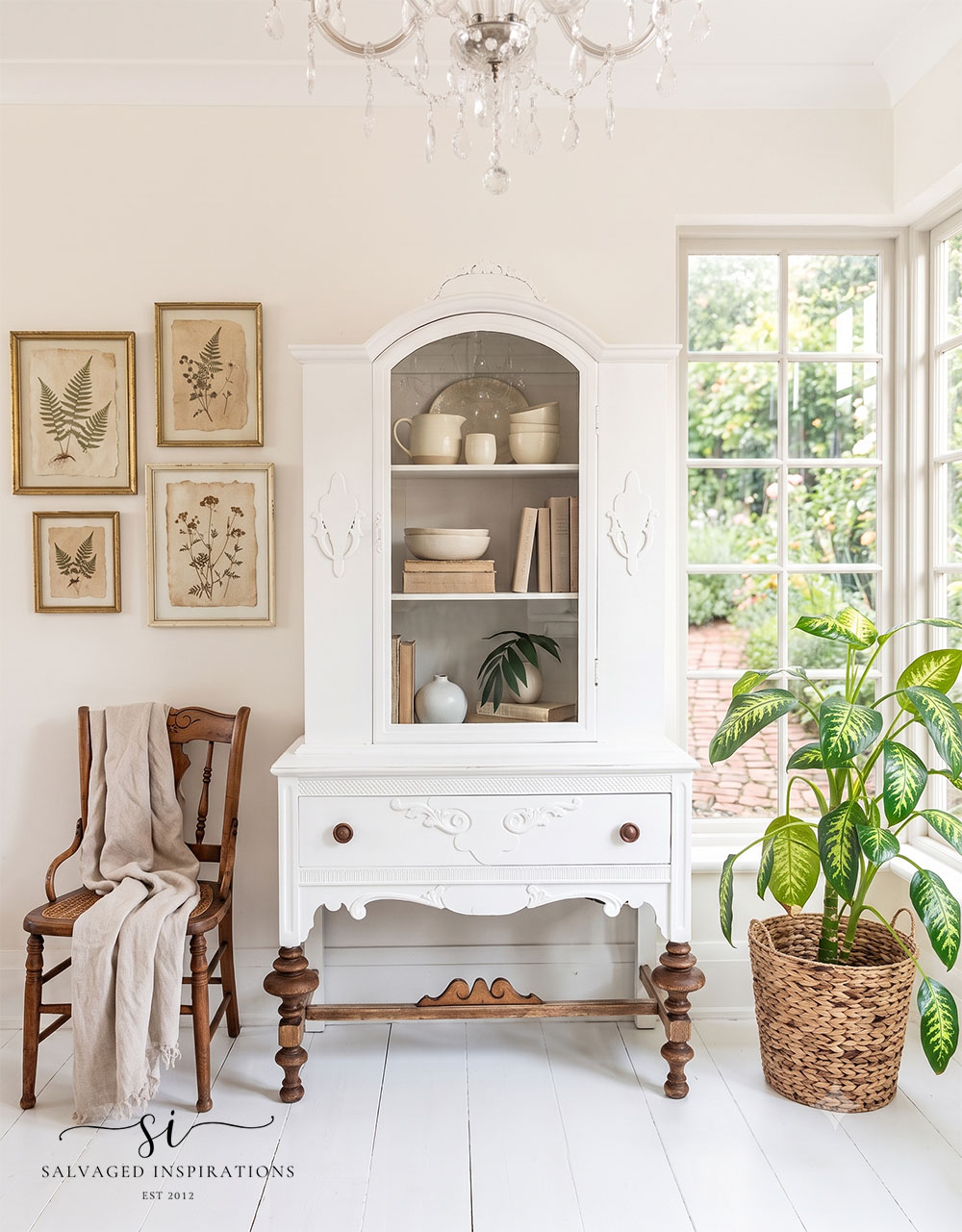
The finished look: gorgeous white finish with bare legs! You can see the full before and after tutorial here.
CURBSHOPPED MAGAZINE TABLE
This magazine table was the sweetest little Easter project. I found it curbside, brought it home, gave it a super good cleaning, and right away saw 100% this was going to be a bleeder. How did I know? Because while cleaning it, that water was running a brown-red, like very dark brewed tea! You can see just how brown/red here!
💡 BLEEDTHROUGH TIP: If you’re cleaning an old piece and the water running off the surface turns brown, yellow, orange, or reddish, that’s my cue to slow down and prepare for possible bleedthrough.
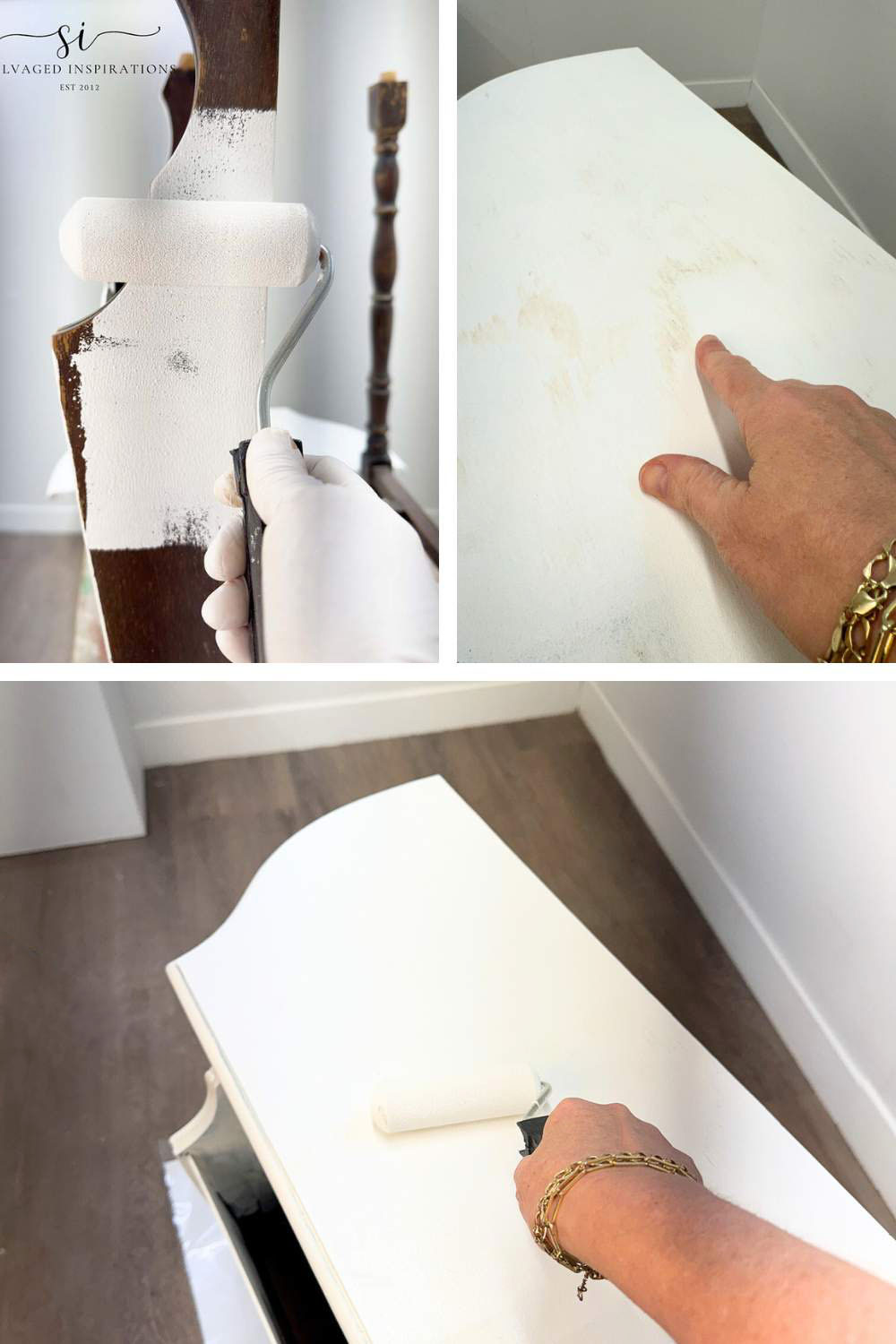
Below is what I saw after painting on the first coat of stain-blocking primer. Sometimes 2 or 3 coats of primer will be needed to stop a stubborn stain.
How sweet it all turned out after…


RESTYLED LEATHER TOP FP TABLE
Here’s a more recent makeover – a lovely 1960s French Provincial side table.
After this piece was scuff-sanded, I primed with this water-based Bonding Boss Primer. This is a great alternative to using a shellac-based primer because it has no odor and easy clean-up. The trade-off is time. This bonding and stain eliminator primer requires 24 hours to activate and do it’s thing. Where as BIN Shellac Based primer dries within a half hour to 45 minutes and you can start painting.
I also wanted to point out that the bleedthrough is only coming through where I sanded through the topcoat.

Here’s the finished look…

And with a little help from AI, we can see how amazing it looks in a room setting…

TAKEAWAY
If there’s one thing I hope you take away from this guide, it’s that bleedthrough is frustrating—but it doesn’t mean your furniture makeover is ruined!
After more than 14 years of painting and refinishing furniture, I’ve learned that a little patience, the right stain-blocking product, and knowing what you’re dealing with can make all the difference.
So don’t give up on that beautiful old piece just because a few stubborn stains decide to show up. I’ve been there, fixed it, and I promise—you can too!
 Hello again... I'm so happy you dropped by! Let's keep in touch! Follow me on social media or sign up for a dose of furniture painting inspiration and diy tutorials. :)
Nothing worse than bleed through on a finished piece!!! 😩 I’ve learned over the years that this one step is worth the effort. Thanks for sharing. It’s a good reminder, Denise. Have a good week. Pinned 📌 xo 😘
It is the worst!… and thank you, you too my friend! XOXO 😘
Thanks for this helpful guide. If you do try the “Advanced” synthetic shellac version of BIN, please share your experience. My local Home Depot seems to have stopped carrying the original version in anything but contractor-sized bucket$$$.
Hi Cyndel and yes, I will! Here in Canada our Homedepot still sells the Shellac Based BIN in gallon and quart size, but I see online, its’ getting a little tricky to find. And I’m guessing different countries have different supply with it as well.
I have not applied my DB Boss yet but I have used Zinsser Odor Killing Interior Primer and it appears the same. I know Odor Killing is specifically for odors, and it works; but does it also help with ‘bleed through’? Do you know if Boss also works for odor blocking? Both products dry clear and I really like that property. I wish there was a dry clear B-I-N on the market!
Hi Lyn! I’m not sure if Z Odor Killing Primer also works on bleedthrough as I’ve never used it. But YES, BOSS does block bleedthrough AND odors. And I agree. Having the option of clear is a game changer. 🙂
Hi! I am working on a frustrating mahogany server. I primed the entire piece with one coat of BIN primer and it looked fine, no signs of bleed through. I painted the first coat with Magnolia Home chalk paint and was very pleased until it dried. There are spotty oil marks coming through in random places. These spots did not appear until after the application of chalk paint. This is my first time using this product. Would another coat of BIN or clear shellac solve this or will it continue if I stay with the chalk paint? Would I be better off switching to an acrylic enamel, and would doing so stop this from happening?
Hi Sharon! Mahogany is notorious for the bleedthrough so I always recommend 2 coats of BIN Shellac Base Primer when working with it… sometimes 3 coats if you’re still seeing any stains. If it’s primed properly, it won’t make a difference in what type of paint you use.
Polyurethane doesn’t block tannins. Not even oil-based polyurethane. Water-based polyurethane is even worse, the water in it often CAUSE tannins to begin leaching through the underlying paint.
Shellac is proven to block tannins from bleedings. Poly doesn’t work.
Hi! I am painting a credenza off white. I primed it with BIN, used 2 coats of chalk paint, and then saw yellowing at the edges. I heard of the shellac trick, so I sanded the yellow areas, applied 2 coats of shellac, repainted, and applied 1 coat of polycrylic. Now I have small cracks all over the areas I used the shellac and painted over! What did I do wrong? It was raining that night and I work in the basement. However, I waited the proper dry times between coats. I’m feeling defeated.
Hi Emily and ugggh, been there and you’ve done nothing wrong. It’s the nature of the product/shellac. When working with shellac, if it’s applied too thick or too many coats, it will have a crackle effect when water-based paint or topcoat is applied over top of it. You would be better off using an additional coat of BIN Shellac Primer (usually 2 coats does the trick but if you still see some discolor creeping through, 3 coats should do it) rather than spot treat with straight shellac. And I know it’s discouraging when pieces end up with obstacles after putting in so much work; it’s happened to me more times than I can count. But if you keep at it and fix it up, the furniture will mean that much more when you look at the beautiful finish. Good luck💜
I’m using the BIN shellac primer over an old buffet. So far have sprayed two coats and still getting pink bleed through. Do I continue with additional coats until I know longer see the pink? Or will I be ok since my finish color will be a dark blue?
Thanks!
Oops…”no”! 🤦♀️
Hi Joan! You should not see the pink stains showing through so I would apply another coat. 🙂
Thank you for the awesome advice. I ended up doing five coats and the end product looks beautiful!!
Hi, I’m having bleed through after 4 coats chalk paint (rust oleum) and then rustoleum chalk paint poly matte clear. Bleed through didn’t appear until after the clear poly. I understand I could go back and apply a stain blocking primer and re-chalk paint and then refinish with sealer, but I’m wondering if I could just re chalk paint and then use wax instead? Would it be safer? Will the wood bleed through wax?
Sorry to hear this Shannon. I know how frustrating it is because I’ve had the EXACT same thing happen to me a number of times. Unfortunately, if it’s bleeding and stain is coming through 4 coats of chalk paint and poly, it would react exactly the same with a wax. Believe me, I’ve tried it and have never won the battle. If you want a short cut (so you don’t have to sand and prime with a stain blocker) you could spray shellac over the bleed-through areas. This will ‘sometimes’ block the problem areas with a couple of coats. Personally, I got tired of guessing and I use BIN Shellac Based Primer everytime now.
So could I use the BIN primer now and then paint and seal or do I have to start all over by sanding it all off (whimper)?
You can def use the BIN now but I would advise to give it a light sanding to even out what you have on there now and also provide a little tooth/scuff for the primer to adhere to.
I had the same problem. My first thing was a nice wood end table that someone had like 5 coats of paint and that way overdone streaking farmhouse look (I guess). I spent so much time stripping it and decided to just paint it instead of staining. The wood wasn’t dark, but I used a light green color from Jolie. I put on several coats and let dry for a week at least before I waxed. It still looked good then I noticed a large red tinged streak on the top. I can’t bear to strip off all that again. I will try what you recommended, Denise, and hope for the best.
I bought an older dresser and prepped it for painting by sanding and wiping down. I have put 2 coats of a good quality primer & paint on it. I have noticed the yellowing bleeding through. I can use one of the products you recommended on top of the paint and this will keep it from happening again? The yellowing will just go away on its own?
Hi Jen! Unfortunately, the yellowing won’t go away on its own. And yes. I would lightly sand to give your new paint some tooth (some scuff for the primer to hold onto). Prime with a stain blocker. Repaint.
Hello,
Beginner crafter here. I am making a couple round wood name signs, and I’m experiencing bleed through. I sanded the boards, stained with dark Mahogany stain, and then used white chalk paint for my big white line across. Lesson learned, to research before starting a project. ;). I have a can of polyurethane (clear semi-glass). If I apply this, should it help stop the bleed through, and would I need to sand off the white chalk paint before applying the polyurethane?
Thank you.
What would you use if you sand down to bare wood and want to milk paint over mahogany? I got red bleed through on my first mahogany piece – which as a fluke actually turned out great on that particular piece. But if you know of a way to avoid that altogether next time, I’d love to know 🙂
Hi Sara! I would use a shellac or a stain blocking primer which you can get in clear if you want a distressed look and some wood showing through. Both work well under milk paint. 🙂
Can you distress a painted piece
A furniture after layering milk paint over shellac or stain blocker
You sure can. 🙂
Dear Denise,
I’m painting an old cabinet of mine. I’ve cleaned, sanded and primed it before applying the paint.
However, after applying a top coat – the white primer became visible in many places. It seems like the color didn’t get a good grip.
Any ideas as to why? And how can I prevent this from happening in the future?
Thanks,
Shahar
Hmm, I’m not sure why that would show up after top coating? Do you mind sharing what products/brands you used?
I used rustoleum chalk paint, Zinsser 1-2-3 primer and a local brand poly (I live in Israel).
An important note is that I have two identical cabinets, and the first one came out perfect, and I basically did the same thing with the second one…
I diluted the paint a bit (with some water, as you recommended to avoid brush marks) – perhaps it was too diluted?
I can think of two things. Just as you said, possibly the paint was a little too diluted OR maybe the primer had some sort of residue on it before you painted??? I’m glad your first cabinet came out perfect… I know how frustrating it can be when things don’t go as planned. 😐
Do you think there’s any way of fixing it without sanding everything and starting over?
Perhaps another coat of paint (over the poly)? Or dark glaze over the white areas?
Thanks!
Shahar, I’m guessing this isn’t your first rodeo because you’re answering your own questions. 🙂 I’m guessing you’d like to keep the two cabinets the same so if I were you I’d opt for the repaint. Give the poly a scuff sanding to create some tooth for the Rustoleum Chalk Paint to grip onto. Then give it one or two coats for full coverage. Then re-topcoat. I hope this helps and good luck. 🙂
I primed all kitchen cabinets using Bin -Advanced Primer White (Synthetic shellac/ Water based). After primer, i do see wood tannins (yellowish/pinkish). I have not started the paint yet (Behr’ kitchen cabinet paint – water based).
What can i do to prevent the tannins coming on top of paint ?
I am using airless spray, for easy clean up, I choose’d water based primer/paint.
I’ve never used or tried Synthetic Shellac Primer so I wouldn’t want to say. Could possibly an additional coat do the trick??? If not, I would contact an associate from where you purchased the primer and ask for their advice.
Thanks for quick reply.
Do you recommend putting a shellac sealer spray where I have stains ? I can sand and then do paint.
My understanding is that sealer will act as blocking layer and will not let the stain show up on paint, But concerned if the sealer will make paint un-even and is it okay to put sealer on top of primer and under paint coats.
Im painting an older dresser for a client, navy blue. I’ve sanded and deglossed it and so much brown is coming off, I’m assuming it’s stain that wasn’t sealed. I was going to seal it with the BIN shellac but since she wants it distressed, you’d see the white primer under it. I have no idea what kind of wood it is… what would you prime with to block any potential bleed thru that is going to be distressed?
Hi Laura! For a distressed look with wood peeking through a clear stain blocking primer is ideal. I’ve used this DB Clear BOSS or clear shellac will also work. If using shellac tho, be careful on how thick and how many coats you apply. If put on too thick it will cause the paint to look like it has a crackle effect. Been there done that..lol.
Hi! After using the BIN shellac primer, am I restricted to certain types of paint for my topcoat?
Also, is shellac treated as oil based paint when thinning and cleaning from a paint sprayer?
Thanks!
Hi Kelli! Oil-based or water-based/latex paints can be used over BIN Shellac Based Primer. And yes, for cleanup solvents are required.
Would Hairspray work, it would be a very quick solution.
Hi Ilse! 🙂 No, hairspray wouldn’t work to stop bleedthrough.
I painted a piece white with a paint that was supposed to be an all in one and had worked beautifully on something else that I thought was similar. I got major pink bleed through on this piece thought. So I plan to shellac it as suggested above- do I sand after the shellac before I paint again? Thanks!
Hi Serena! You sure can but be sure it’s a very light scuff sanding. You don’t want to sand down the shellac, but rather scuff it up to give something for the paint to grip onto.
Hi there!!! After applying the shellac primer and then adding the chalk paint am I still able to distress the piece? The primer a white so I wasn’t sure? Also can you get a clear primer?
Thankyou Jodie!!!
The white shellac-based primer is not the best to use if you want to distress down to wood because once you sand, you often will see white underneath. A clear shellac or primer is best suited. A really good one I use is this one here.
I am getting ready to paint family room walls which are tongue and groove wood, beautiful solid wood with some knots. I am using SW Aesthetic white and worried about bleed thru. This is an inside project and I worry about smell, the room is 24 x 14. Any primer that works that won’t be horrendous in odor?
I would contact your local SW retailer and ask about their synthetic shellac primer. I haven’t tried it but I’ve heard good things.
We are refinishing an old desk. We deglossed the whole thing first, then sanded and painted the coats using a light grey latex paint and primer in one. It looked great until we put the polycrylic sealer on it. When the first coat of sealer had dried, you can now see the stain coming up through the paint. I’m not sure what to do next. Do I need to sand the sealer to give it grip before I repaint with the grey? Do I need to put a stain blocker on to of the sealer before I repaint with the grey? Do I need to sand it down all the way to wood, then start all over with a stain blocker? I’m hoping you can help me figure out what to do next!
Hi Theresa! Unfortunately, this happens a lot when working with old furniture. I got tired of ‘guessing’ whether a primer was going to block bleedthrough so my go-to primer is B-I-N Shellac Based Primermy go-to primer is B-I-N Shellac Based Primer because you can actually SEE when all the bleedthrough is covered – and be 100% sure it won’t show through after top coating. If this were my desk, I would sand to remove the sealer. Not all the way down to the wood, but a good enough sanding to remove the topcoat and give the grey paint some tooth. Then prime with a stain-blocking primerwith a stain-blocking primer. Then repaint. Then topcoat. I know this isn’t ideal after you put in ALL that work, believe me i know because I’ve been there! I hope this helps and good luck. 🙂
Hi there! I bought a can of shellac after there was major stain bleed through the white chalk paint I used on a chair. For the remaining chairs, Would you recommend more than one coat of shellac to be safe or is one enough?
I wish there was a straight answer to this question Tessie. 🙁 A lot depends on the type of wood and how it reacts. If they were my chairs, I would try one chair with one coat and see how it reacts once painted. I try to use less shellac if possible because there have been a few occasions I added more shellac coats and ended up with a crackle finish… so I learned it’s best to use the shellac sparingly. Now I use BIN Shellac PrimerBIN Shellac Primer so I could actually see when the bleedthrough is 100% covered which I find helpful.
How long after did the crackle appear? I’m doing custom job and wanted to make sure if it happens before I add fusion mineral paint.
HI Denise
So I sanded a mohagony dresser and painted it white and it is bleeding through after two coats.. can I put the primer after the white paint or do I have to re sand it again and start over? Thanks Julie
Hi Julie! If it were my piece I would sand the white paint (you don’t have to sand it off but just enough to scruff it up so the primer sticks) and then prime again.
Hey Denise, I’ve stained a set of cornhole boards with mahogany stain for the designs. The look great, but when I go to put on the poly coat, the stain starts to bleed into parts it shouldn’t. Is there a specific polyurethane I should use to solve this issue? Thanks
Hi Wyatt, I’m going to guess that the stain is not yet 100% dry OR all the excess stain was not wiped back. Also, if you’re using an oil-based stain and top coating with a polyurethane (oil-based) the same-same solvents mix together and bleed out if the stain has not totally dried. Hope this helps. 🙂
I have a coffee table that I already have finished with chalk paint and a wax finish. How do I now change the color? Do I have to get the wax off first?
Hi Linda! If the wax is cured, you can give it a light sanding and then repaint with chalk paint. 🙂
Hi Denise
I was painting an old desk with chalk paint, and got some yellowing as well as stain bleed through. I’ve since found out that you do need to use a stain blocker, when using chalk paint on an old piece. I’ve sanded a lot off, but not to the point of being pristine. Are you able to put the stain blocker on top of the paint, or do you need to sand it fully?
H Stephen! I don’t sand fully before priming or repainting. No need. If you’ve sanded the paint smooth and given it some ‘tooth’ you can then go ahead and apply your primer. This primer is my #1 choice.
Hi Denise, I painted a candlestick and the paint started peeling off. Now this is no small candlestick,.it is about 2″ tall with a lot of crevices and detail. So, I didn’t want to remove the paint but I thought if I painted shellac over it, that would solve my problem. OH BUT NOT AT ALL!! It is still peeling. I researched and found something called Peel Stop by Zinsser and wanted to ask you if you have ever used this product. It’s a bit pricey so I didn’t want to invest in a can if it doesn’t really stop paint from peeling. I appreciate your feedback.
Hi Cecilia! Ohhh no. I know how frustrating this is once you’ve put in the time and effort to spiff it up… uggggh. Unfortunately, I can’t chime in on the Peel Stop because I’ve never tried it. What I will say is Zinsser products on a whole are excellent!!! I’m working on a video right now with Zinnser B-I-N primer. If you give this Peel Stop a try, can you leave me a note on how it works? I’d love to hear your results.
What if the paint i have used as primer/paint and still bleed through happens. I have put two coats on .
Hi Susan. If I’m understanding this correctly, if it’s a paint and primer in one and the bleedthrough is still showing through, it may be beneficial to give it a light sanding/scruff and apply a heavy duty primer or shellac to seal before painting. BIN Shellac Primer works SUPER well!
If I use the primer and then paint with chalk paint, can I still distress with sandpaper?
You can but if you use what primer, the white will be visible underneath. Dixie Belle has a clear stain blocker so the natural wood can show through once sanding back. It goes on milky but dries clear.